Description:
In the course of the continuous exhibition series “Archdiploma”, representing the best diploma projects of the Faculty of Architecture and City Planning of Vienna University of Technology, we had to create an exhibition wall, which was set up in the ”project space” of Kunsthalle Wien.
The goal was designing and fabricating a parametric wall in summer term 2009 for the upcoming exhibition, using digital design methods. We should only use planar quads, milled out of EPS boards. The given time limit was the end of the summer term 2009.
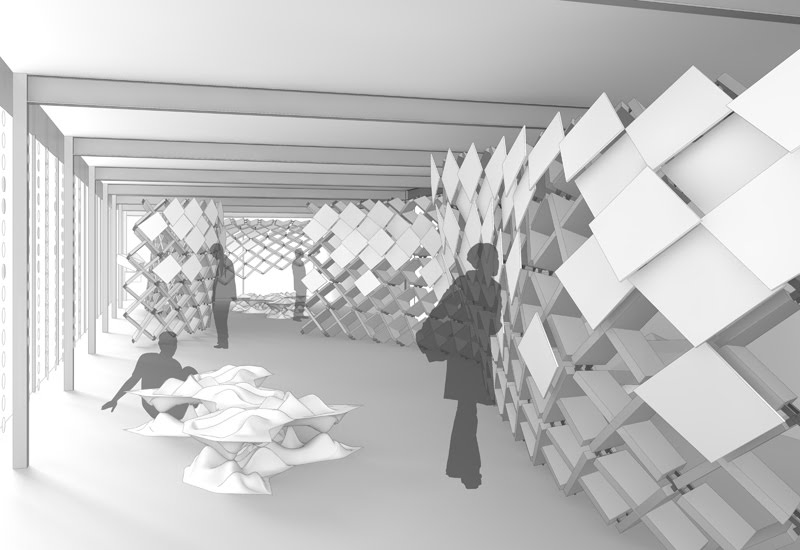
X-Blur represents the attempt of interpreting architecture exhibitions in a new way and reinventing our usual traditional viewing habits, and literally turning our visions. The basic concept targets on the direct approach of the visitor, the material physical act of viewing, which requests the visitor to explore the whole exhibition, and not to only passively roam through it, one should take a closer look behind the scenes. In the conception of spatial separation between architectural models and visitors space, one should be animated to cross the border of the wall and therewith to blur the borders. At the beginning, the visitor’s view is limited by the structural grid, only a few views are visible simultaneously from one position. Only by moving along the wall, the models will appear and the whole exhibition becomes visible by continuous exploring.
The spatial concept is based on the orthogonal structural grid of the Kunsthalle Wien, and turns by 45° degree from its origin position. Thus the transformed grid provides the base of the conception of the exhibition wall. By using the body diagonal and the proportioning principle of the original space, the position and the lengths of the new wall segments are defined and dissolved.The wall and its segments do not only correspond with their present and temporary housing, but there is also the interaction with the models behind it and the viewers focus points which form – and deform – the structure of the design wall and its grid.
The architectural models are supported by projections which add more details to the single projects. The images are being projected over multiple fields of uncontinuous pixel array and split. On the front of the projection planes, the typical structure of the wall will be repeated and blurs the visual perception.